
The Company assesses material sustainability topics in accordance with the Global Reporting Initiative (GRI) framework to inform the development of appropriate management approaches for each issue. The Company has established the following process to identify material sustainability topics:
Identifying Key Sustainability Concerns
Identifying key sustainability issues relevant to the business by taking into account the expectations of all stakeholder groups, global business trends, and critical factors within the industry sector.
Prioritization of Key Sustainability Issues
Prioritizing the importance of sustainability issues into four levels of significance: Highest, High, Moderate, and Low.
Reviewing Sustainability Issues
Summarizing the findings of key sustainability issues and presenting them to the Board of Directors for evaluation and approval of the sustainability assessment results.
Reviewing Sustainability Issues
Summarizing the findings of key sustainability issues and presenting them to the Board of Directors for evaluation and approval of the sustainability assessment results.
Reviewing Sustainability Issues
Summarizing the findings of key sustainability issues and presenting them to the Board of Directors for evaluation and approval of the sustainability assessment results.
2025 Materiality Assessment Results
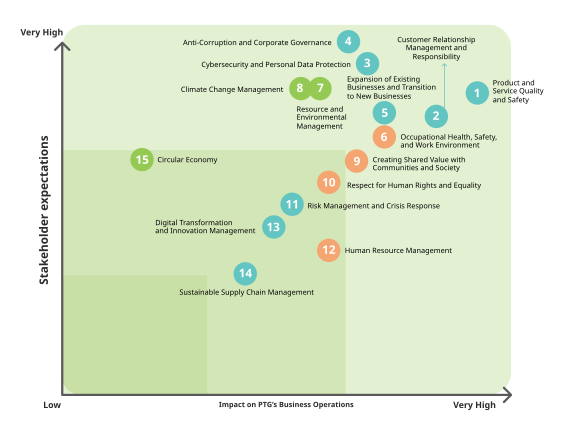
| Ranking | Materiality Issues | Impact Level |
|---|---|---|
| 1 | Product and Service Quality and Safety | 4.49 |
| 2 | Customer Relationship Management and Responsibility | 4.41 |
| 3 | Cybersecurity and Personal Data Protection | 4.40 |
| 4 | Anti-Corruption and Corporate Governance | 4.40 |
| 5 | Expansion of Existing Businesses and Transition to New Businesses | 4.38 |
| 6 | Occupational Health, Safety, and Work Environment | 4.36 |
| 7 | Resource and Environmental Management | 4.34 |
| 8 | Climate Change Management | 4.27 |
| 9 | Creating Shared Value with Communities and Society | 4.22 |
| 10 | Respect for Human Rights and Equality | 4.26 |
| 11 | Risk Management and Crisis Response | 4.20 |
| 12 | Human Resource Management | 4.20 |
| 13 | Digital Transformation and Innovation Management | 4.16 |
| 14 | Sustainable Supply Chain Management | 4.09 |
| 15 | Circular Economy | 4.08 |
These material sustainability issues will be incorporated into the enterprise risk identification process, serving as supplementary information alongside changes in internal and external factors that may arise, in order to identify organizational risks. In addition, these material sustainability issues are used to validate significant enterprise-level risks, with their relationships to enterprise risks shown in the table below.
| Related Sustainability Issues | Enterprise Risks | Risk Categories |
|---|---|---|
| Human Resource Management | Risks arising from human resource management | Operational Risk |
| Digital Transformation and Innovation Management | Risks related to adapting to and adopting new technologies | Operational Risk |
| Expansion of Existing Businesses and Transition to New Businesses | Risks from business expansion or investment in new businesses not generating expected returns | Financial Risk |
| Risk Management and Crisis Response | Risks from severe incidents that may disrupt business operations | Operational Risk |
| Occupational Health, Safety, and Work Environment | ||
| Cybersecurity and Personal Data Protection | ||
| Resource and Environmental Management | Corporate sustainability risks | Operational Risk |
| Climate Change | ||
| Respect for Human Rights and Equality | ||
| Product Quality and Safety | Risks that may affect credibility and reputation | Operational Risk |
| Customer Relationship Management and Responsibility | ||
| Creating Shared Value with Communities | ||
| Anti-Corruption and Corporate Governance | Compliance and regulatory risks | Compliance Risk |