

The Company firmly believes that developing employees’ potential, alongside enhancing their quality of life and organizational engagement, forms the foundation of sustainable growth. We are committed to creating a supportive and inclusive work environment where everyone has the opportunity to learn, grow, and move forward together.
Key Stakeholders Affected

Stakeholder Impact

Business Impact
Performance Against Targets
Employee engagement level
%
2027
%
2025
%
2025
Management Approach

The Company is committed to managing human resources with fairness, transparency, and respect for the equal value of all employees. Emphasis is placed on comprehensive recruitment, development, and employee care, including appropriate compensation and benefits, workplace safety, and a positive working environment, as well as opportunities for continuous learning and career advancement. The Company promotes its “Do Your BEST” core values to foster engagement, pride, and motivation among employees. By creating a supportive and empowering workplace, the Company enables employees to perform at their full potential and grow sustainably alongside the organization.
Labor Management
Fair Labor Practices
Paying a Living Wage
Equal Remuneration for Men and Women
Setting Maximum Working Hours
Working hours are defined according to job functions:
- Head Office: Four shifts are implemented. Shift 1: 7.30 a.m.–4.30 p.m.; Shift 2: 8.30 a.m.–5.30 p.m.; Shift 3: 9.30 a.m.–6.30 p.m.; and Shift 4: 10.30 a.m.–7.30 p.m.
- Branch Offices, categorized by type of service. Regular work: 8.00 a.m.–5.00 p.m. Laboratory (LAB): 8.00 a.m.–5.00 p.m. Shift work: 2–3 shifts, each 8 hours, depending on branch operations. Transportation work: 7 hours per day to maintain safety and efficiency.
For off-site roles such as marketing, sales, system installation, or inspections, working hours are determined according to job nature. Overall, total working hours do not exceed 48 hours per week, and overtime, including on holidays, does not exceed 36 hours per week, ensuring employees maintain a healthy work-life balance.
Avoiding or Reducing Overtime or Excessive Working Hours
Paid Annual Leave Entitlements
Consultation and Notice Prior to Mass Terminations
Freedom of Association and Collective Bargaining
Recruitment Performance Outlook
Growth Rate
(Compared to 2024)
Employment of Vulnerable Groups
Employment of the Elderly
The Company promotes the employment of elderly individuals, recognizing their potential, experience, and value to both the organization and society. Suitable roles are provided, such as forecourt staff at fuel stations, along with post-retirement employment extensions. Initiatives such as the “Punthai Senior Project” create opportunities for seniors to remain employed. This approach enhances income, dignity, and quality of life for the elderly, reflecting the Company’s commitment to supporting an aging society and sustainable development.
Elderly Employment Project
Employment Value (Million Baht)
Number of Elderly Employees (Persons)
Employment of Persons with Disabilities
The Company fully complies with legal requirements under Sections 33 and 35 regarding the employment and empowerment of persons with disabilities. Opportunities are provided both within Company premises, such as forecourt and office positions, and through service outsourcing and vocational development programs in collaboration with partner networks. Progress and related activities are regularly communicated to reflect the Company’s commitment to inclusive, equitable employment and strict legal compliance.
Disability Employment Project
Employment Value (Million Baht)
Number of Employees with Disabilities (Persons)
Employment under Section 33
Employment under Section 35
Building Organizational Culture
The Company strives to cultivate an organizational culture that aligns employees’ behaviors and ways of working with its long-term strategic goals. Through continuous communication and targeted engagement activities, it fosters a positive work environment that supports overall organizational success and aligns with its vision to “connect everyone to opportunities for a better quality of life at every stage of life.” To embed this culture across all levels, the Company has established the core values “BEST” as guiding principles for employees, from onboarding and leadership development programs to knowledge-sharing activities and employee recognition through the BEST Awards, ensuring tangible and sustainable cultural transformation.
“Do Your BEST”
Employee Engagement Assessment Results for 2025

Employee Development and Training
Outcomes of Employee Capability Development for Employees and the Business
The Company focuses on developing employee capabilities across two key dimensions: enhancing work-related skills (Skill Growth) and strengthening role-based competencies through functional and managerial skill programs. A Skill Assessment tool is utilized to measure competency levels before and after training.
From the evaluation of 198 assessed training programs, employees demonstrated an average skill improvement of 79%, reflecting the effectiveness of the program design and learning processes aligned with job roles and operational requirements.
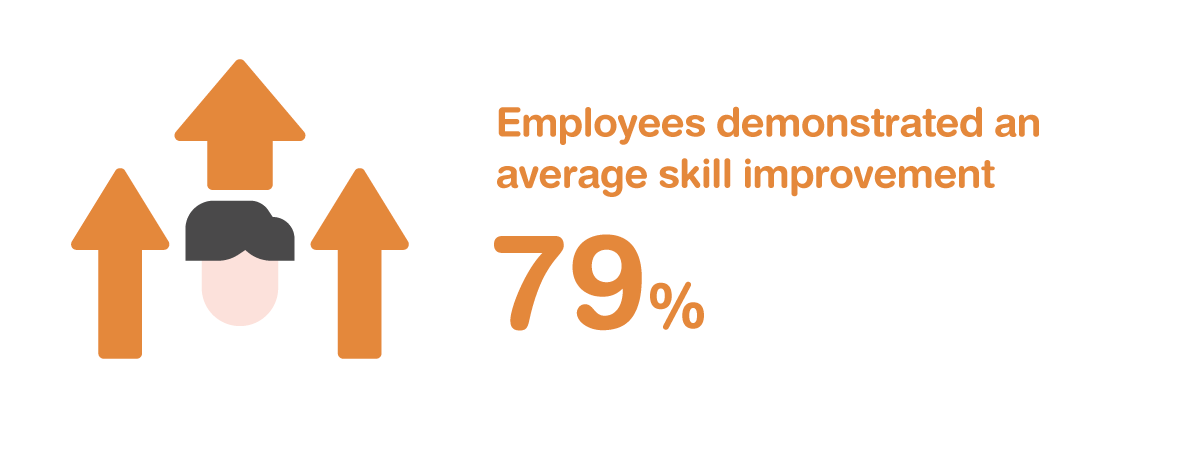
When analyzed by program category, Leadership, Functional, Common, and Onboarding programs showed particularly high levels of skill improvement. This highlights the programs’ effectiveness in strengthening essential functional capabilities, managerial competencies, and job readiness at each stage of employees’ career journeys.
The employee development programs cover employees at all levels across the Company, including permanent employees, contractual employees, daily workers, and part-time employees. The Company provides access to learning and skills development opportunities that are appropriate to the roles, responsibilities, and nature of work of each employee group.
Business Benefits from Executive and Employee Training
| Training Program / Course | Benefits to Executives and Employees | Benefits to the Business | Proportion of Program Training Hours to Total Training Hours (FTE Basis) |
|---|---|---|---|
| Executive | |||
| Course: Risk Management Training for Executives Objective: To build awareness and understanding of risk management among senior executives, enabling them to identify strategic risks and incorporate them appropriately into decision-making processes. |
Executives gain a comprehensive view of risks and make decisions with greater confidence. | Reduce the likelihood and impact of risks that may affect enterprise-wide business operations. | FTE = 0.02 Total program hours: 3 hours |
| Course: Google AI for Executives – Gemini for Google Workspace Objective: To enhance executives’ capabilities in utilizing Google AI (Gemini for Google Workspace) to improve work efficiency, decision-making, and management effectiveness in the digital era in an appropriate and secure manner. |
Senior executives develop a clear understanding and appropriate perspective on the use of AI in the workplace and are able to apply it effectively in their leadership roles. | Increase the adoption rate of AI in executive management and decision-making, enhancing operational efficiency and driving long-term organizational performance. | FTE = 0.02 Total program hours: 3 hours |
| Course: Talent Transform Mastery Program Objective: To develop high-potential executives to drive transformation, deliver business results, and grow sustainably as future leaders. |
A pool of executives is developed and prepared to assume key roles and drive sustainable organizational growth. | Reduce the risk of critical position vacancies and tangibly improve talent readiness for critical roles. | FTE = 0.30 Total program hours: 60 hours |
| Course: Leading Beyond Silo Objective: To cultivate leadership that connects people, perspectives, and goals in order to align the organization toward a unified direction. |
Executives are able to work seamlessly across functions, gain a clear organizational overview, and effectively drive shared goals. | Foster leadership that connects people, perspectives, and goals to align the organization in a unified direction. | FTE = 0.01 Total program hours: 1.5 hours |
| Course: Future-Ready Leaders Development Program Objective: To prepare future successors with strong leadership capabilities, strategic perspectives, and change management skills to support sustainable organizational growth and continuity. |
The organization gains confidence in having ready successors who can assume critical roles and ensure smooth leadership transitions without disrupting business operations. | Build confidence in having capable successors ready to assume key roles, minimizing people-related risks and ensuring future business continuity. | FTE = 0.11 Total program hours: 22 hours |
| Course: Leading to Success: Strategy on Tour Objective: To build a shared understanding of the organization’s direction, strategy, and goals; align the roles of executives and teams; and drive the effective execution of strategy into tangible results. |
Executives have a clear and aligned understanding of the organization’s strategy and direction, and are able to effectively communicate and translate strategy into action. | Improve the effectiveness of translating strategy into action at the departmental level, reduce misalignment in strategic execution, and strengthen collaboration among executives. | FTE = 0.08 Total program hours: 15 hours |
| Employee | |||
| Course: Station Standards Program The Station Standards Program is designed to develop practical operational skills among frontline employees at service stations, enhancing functional skills that directly impact business performance. Objective:
|
|
Enhances service standards and operational practices across service stations, ensuring consistent service quality, improving operational efficiency, and strengthening customer satisfaction and trust. | FTE = 0.083 Total program hours: 36 hours |
| Course: Customer Handling The Customer Handling course is designed to enhance the readiness of operational staff to create positive impressions and respond promptly to customer needs. Objective:
|
|
Improves service quality and customer experience, helping to reduce customer complaints while increasing overall customer satisfaction. | FTE = 0.434 Total program hours: 6.9 hours |
| Course: Complaint Handling The Complaint Handling course aims to strengthen service capabilities when facing customer complaints or immediate issues raised at service stations. Objective:
|
|
Enables employees to handle complaints appropriately and in a timely manner, reducing conflicts and minimizing potential impacts on the Company’s reputation. | FTE = 3 Total program hours: 24 hours |
| Course: Product Presentation Techniques This course enhances the skills of operational staff in effectively presenting product benefits to customers. Objective:
|
|
Enhances the effectiveness of presenting products and benefits that align with customer needs, creating opportunities to increase sales and generate additional revenue for service stations. | FTE = 0.20 Total program hours: 15 hours |
| Course: 16-Step Fueling Procedure The 16-Step Fueling Procedure course is designed for operational-level employees. Objective:
|
|
Reduces service errors and potential damages caused by incorrect fuel dispensing, minimizing corrective costs while reinforcing customer confidence in the service stations. | FTE = 0.33 Total program hours: 27 hours |
Performance Evaluation
1. Management by Objectives
2. Agile conversations
The Company encourages employees and supervisors to engage in One-on-One discussions and provide performance feedback throughout the year. These discussions are used to monitor progress, review or adjust goals and KPIs as appropriate, identify obstacles, and determine actions to improve employee performance.
3. Multidimensional Performance Appraisal
Remuneration and Benefits
Short-Term Incentives
The Company provides short-term incentive compensation to align employee performance with business objectives and support sustainable growth. These include:
All payments are made accurately and on time under clear, transparent, and auditable criteria, with due consideration to fairness, workplace safety, and business ethics. This approach strengthens employee motivation, engagement, and shared organizational success.
Long-Term Incentives
The Company offers long-term incentive programs to foster employee retention and align employees’ interests with organizational growth, including:
The Company also promotes wellness initiatives to support employees’ long-term well-being and work capability. Compensation structures are regularly reviewed against market benchmarks and internal evaluations to ensure fairness and competitiveness under transparent governance and sustainable growth principles.
Female-to-Male Pay Ratio

1.08 : 1
1.11 : 1

0.99 : 1
0.99 : 1

0.67 : 1
Outstanding Employee Welfare Programs
Football & Badminton
Court Rental
Accident Insurance
Reassignment or
Cosmetic Surgery
Paternity Leave
Return on Human Capital
| Indicators | 2021 | 2022 | 2023 | 2024 | 2025 |
|---|---|---|---|---|---|
| Total Revenue (Million Baht) | 133,758.82 | 179,422.42 | 198,811.06 | 225,812.95 | 224,341.30 |
| Administrative Expenses (Million Baht) | 8,270.8 | 9,764.5 | 11,008.73 | 12,884.15 | 15,696.00 |
| Human Resource Expenses (Million Baht) | 3,542.47 | 3,542.47 | 4,544.46 | 5,400.45 | 6,796.02 |
| Human Capital Return on Investment (HC ROI) | 36.42 | 46.65 | 42.33 | 40.43 | 31.70 |