
PTG Group is committed to fostering a strong safety culture as an integral part of everyone’s daily work practices. Through the implementation of Safety Visible Leadership under the PTG SSHEMS framework, we strive toward our ultimate goal of achieving zero accidents.
Key Stakeholders Affected

Stakeholder Impact

Business Impact
Performance Against Targets
Total Recordable Injuries Rate
(TRIR)
of Employees
Year 2027
Year 2025
Year 2025
Management Approach

The Company has established policies on Quality, Security, Safety, Occupational Health, and Environment (SSHE) as a governance framework across the PTG Group. These policies are regularly reviewed by the SSHE Steering Committee to ensure alignment with evolving internal and external contexts. The Company has developed the SSHE management system of the Group under the name PTG SSHEMS, to serve as the core system for setting direction, standards, and management processes for SSHE, ensuring consistency across the entire Group. All PTG Group companies are required to apply this system as a foundation for operations, covering the assignment of roles and responsibilities, risk management, operational control, and systematic monitoring. In addition, the Company arranges for the system to be audited at least once a year, together with audits against international standards such as ISO 9001, ISO 14001, and ISO 45001, to continuously enhance effectiveness and alignment with best practices.
Safety, Occupational Health, and Environmental Structure and Policies
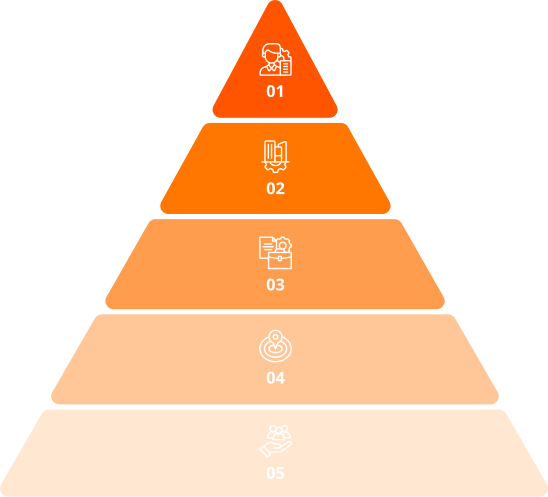
In managing the Group’s PTG SSHEMS system, the management structure is organized into 5 levels, as follows:
Level 1 – Management
The Company appoints a committee to oversee Security, Safety, Occupational Health, and Environment, to determine direction, policy, and governance of PTG SSHEMS operations across the PTG Group.
Level 2 – PTG Group Level
The Company establishes the Security, Safety, Occupational Health, and Environmental Management Standard (PTG SSHEMS) to serve as the foundational standard for management within the Group, under the principles of good corporate governance.
Level 3 – Business Unit (BU)
Each business unit must develop a management system in accordance with the PTG SSHEMS standard and may additionally apply relevant international standards suited to the nature of its business, as appropriate.
Level 4 – Area of Operation
Operational areas must comply with the PTG SSHEMS system and undergo an audit at least once a year, achieving a PTG SSHEMS Score in line with the Company’s criteria. Operations are driven under the supervision of the area’s Safety Committee.
Level 5 – Employees (Operation)
All employees must comply with the Safety, Occupational Health, and Environmental culture (BESAFE) and continuously participate in safety promotion activities in line with the Company’s guidelines, to support the goal of reducing accidents and achieving Zero Accident.
Operational Excellence in Safety, Occupational Health, and Environment
The Company is committed to continuously enhancing its Security, Safety, Occupational Health, and Environment (SSHE) management system in compliance with applicable laws and international standards, by applying the PTG SSHEMS system as its core framework and operating in line with the ISO 45001 standard to continuously raise the level of safety for employees, customers, communities, and the environment.
Management System and Zero Accident Goal
Corporate Safety, Occupational Health, and Environmental Management System
Under the Security, Safety, Occupational Health, and Environmental management framework of PTG SSHEMS, the Company has prepared a 5-year development plan (2022–2026) to elevate management practices to cover the entire Group, with the goal of becoming a holistic safety organization. This covers the prevention of accidents from work operations, product transportation, incidents affecting the environment, as well as incidents that could lead to emergency or crisis situations.
In addition to the PTG SSHEMS management system, the Company has adopted the following international standards:



Zero Accident Target
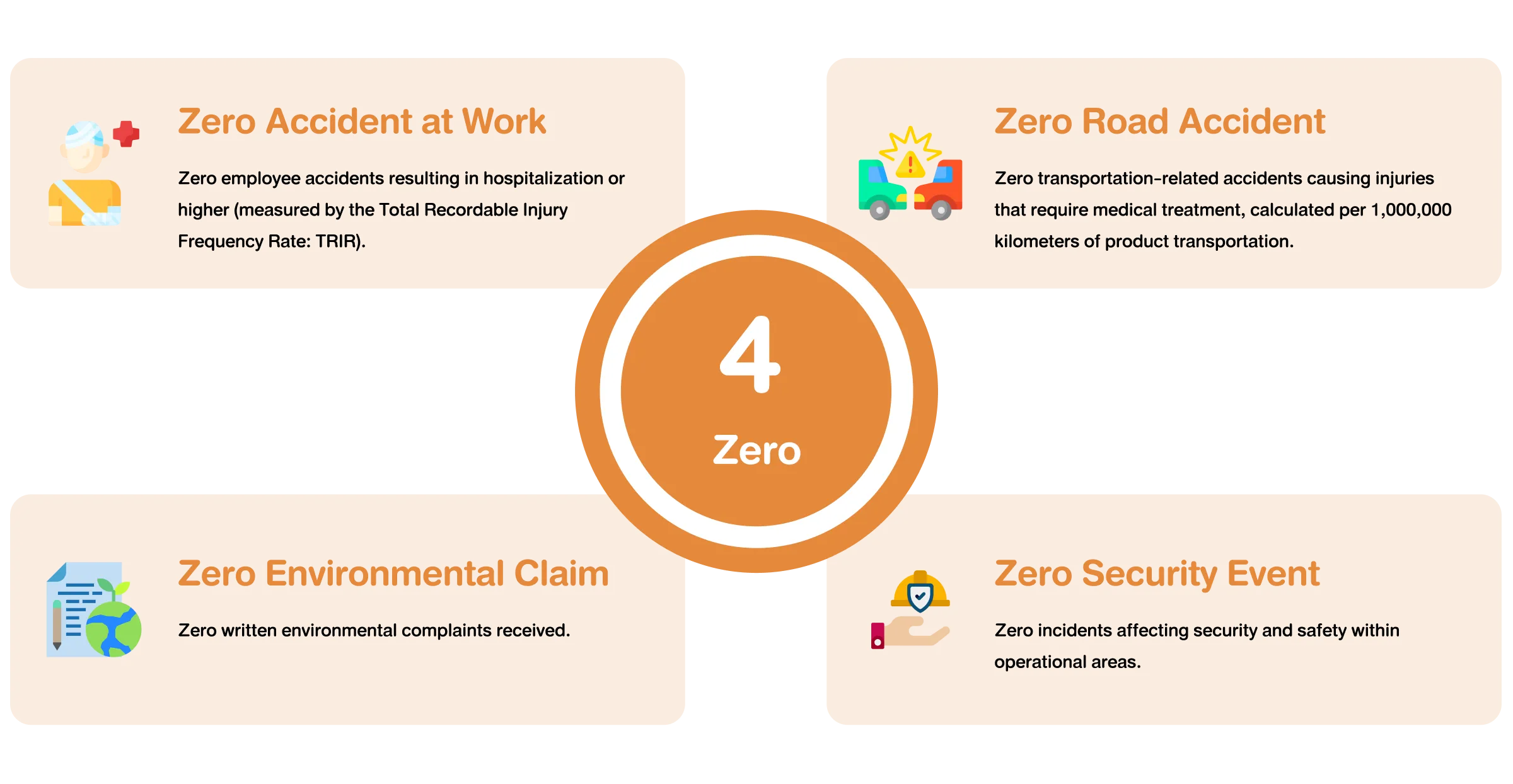
The Company has set an important goal of reducing accidents to zero (Zero Accident), covering more than just the prevention of workplace accidents, and extending its scope to holistic safety management, as follows:
To support the achievement of this goal, the Company continuously carries out engagement activities and monitors performance results at operational sites, with each area required to work toward the “4 Zero” targets. Sites that successfully achieve the targets are recognized and honored at the annual BESAFE Award.
0
Accidents
In 2022–2025
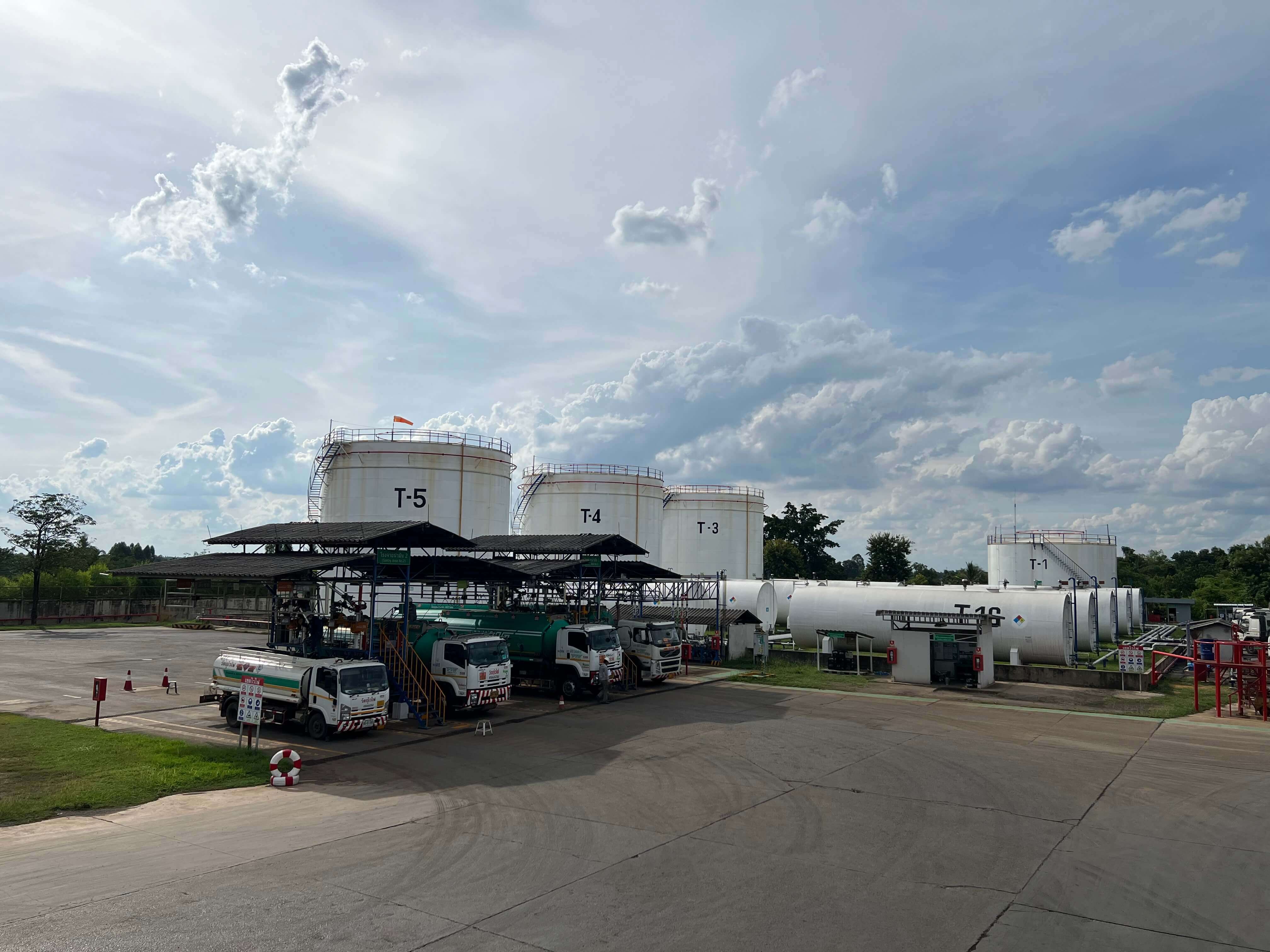
The Company was able to manage safety holistically with zero accidents and incidents across all four categories at its oil depot operational sites, reflecting the effectiveness of the PTG SSHEMS system. The Company remains committed to continuously developing and enhancing the PTG SSHEMS to achieve its holistic Zero Accident goal, and to strengthen stability and sustainability in its long-term business operations.Safety, Occupational Health, and Environmental Culture (BESAFE)
The Company has established a unified safety culture across the organization under the concept of “BESAFE: Get Beyond Safety, Do Your BEST,” aligned with the corporate BEST culture, to instill safety awareness as part of operations at every level of the organization. The BESAFE safety culture consists of the following key principles:
“ BESAFE ”

Risk Assessment and Prevention
Identification of Work-Related Hazards (Risk Assessment)
The Company places importance on identifying hazards that may be associated with work operations (risk assessment), to systematically manage and prevent risks arising from employees’ work. The Company reviews and assesses safety risks at least once a year, or whenever there is a change in operations, in order to prevent accidents and raise the level of safety in operations, under the Security, Safety, Occupational Health, and Environmental Management (PTG SSHEMS) framework. The risk assessment results classify safety risk into 4 levels: Very High Risk, High Risk, Medium Risk, and Low Risk.
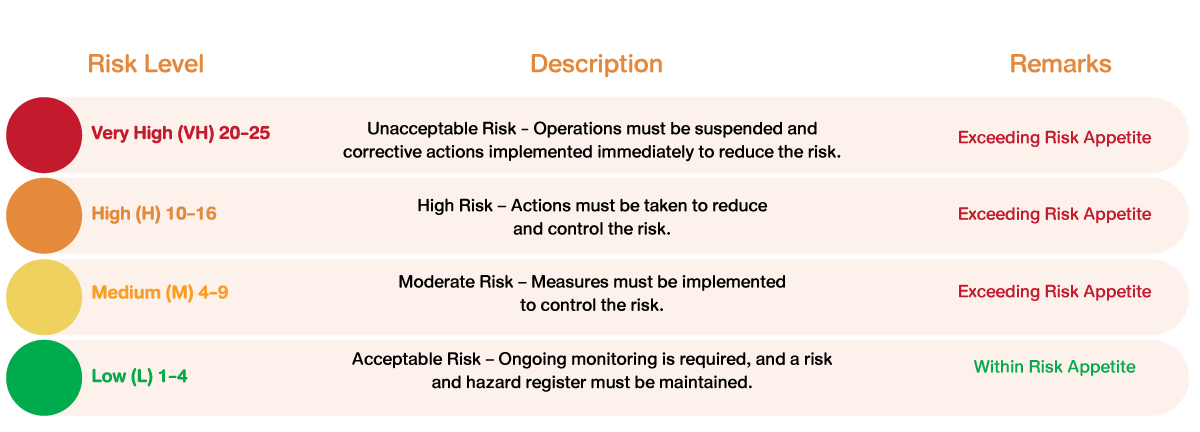
The Company has established measures to assess and control risks comprehensively across all relevant dimensions, divided into 5 main areas, as follows:
| Occupational Safety Risk | Assessment of risks arising from mismatches or imbalances between workers and the tasks they must perform, which may lead to work-related illness, using the risk assessment method under the Occupational Health and Safety Management System, ISO 45001 |
| Environmental Risk | Assessment of any change to the environment, whether beneficial or adverse, in whole or in part, resulting from the organization’s environmental aspects, using the risk assessment method under the Environmental Management System, ISO 14001 |
| Worker Health Risk | Assessment of the likelihood or chance that workers exposed to hazardous chemicals or other physical risk factors will experience health effects from exposure to one or more risk factors simultaneously, using the Health Risk Assessment method under Ministry of Industry Notification No. 4439 (B.E. 2555) on Health Risk Assessment from Chemical Exposure |
| Security Risk | Assessment of the likelihood of safety and security events that may affect people, property, business operations, the environment, information, and the organization’s reputation, in order to establish appropriate prevention and mitigation measures, using the risk assessment method under API 780: Security Vulnerability Assessment |
| Transportation Risk | Assessment and management of transportation risk under ISO 39001: Road Traffic Safety Management System, to systematically control and reduce the risk of road accidents |
After completing the risk assessment, each operational area prioritizes risks in accordance with risk management principles (Risk Priority), to establish appropriate prevention and corrective measures. The area’s Safety Committee is responsible for monitoring the progress of corrective action on significant risks, and for communicating with relevant employees to ensure awareness and understanding of such risks, until corrective action has been completed.
Safety Risk Assessment Results
Based on the assessment of safety, occupational health, and environmental risks and opportunities under the PTG SSHEMS system, the results reflect that most risks are at the medium level, with some activities at the high risk level. The assessment results have been used to establish and implement key risk management measures, as follows:
| Operational Area | Key Risk Issues | Overall Risk Level | Risk Management Measures |
|---|---|---|---|
| Oil Depots and Headquarters |
|
Moderate – High |
|
| Service Stations |
|
Moderate |
|
The Company has established and applied safety, occupational health, and environmental measures to control risks systematically, together with continuous monitoring, promoting the participation of employees at all levels in risk management through the Safety Hunter project and Safety Line Alerts, to give employees the opportunity to help identify, alert, and report risks in the operational area, focusing on managing potential near-miss incidents before they develop into severe accidents or losses, in support of the Zero Accident goal and long-term sustainable business operations.
Promotion of a Safety Culture
Safety Promotion for Contractors and Business Partners
The approach to promoting safety among contractors and business partners, led by the Contractor Safety Inspection Department under the Safety and Environment Division, is implemented systematically and comprehensively across all stages of operations, as follows:
Pre-Work Communication of Requirements
Pre-Work Safety Training
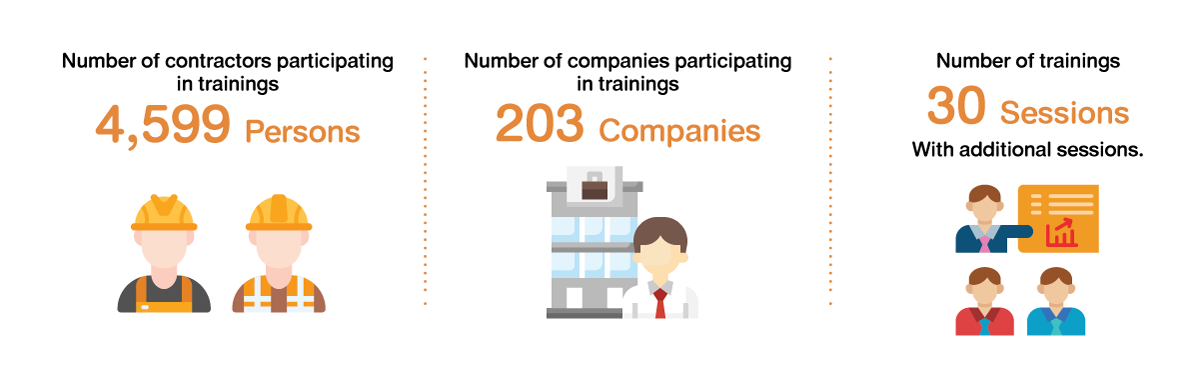
All contractors must pass safety training in accordance with the plan before starting actual operations, with an annual training plan prepared in advance, and special training sessions arranged for emergency cases.
The Contractor Safety Inspection Department, under the Safety and Environment Division, has continuously conducted safety training for contractors’ employees before starting every project, in line with the 2025 annual training plan. All contractors must pass safety training in accordance with the plan before starting actual operations. The Company requires every contractor worker to undergo safety training in accordance with Company regulations before starting work, with training held twice a month, after which workers receive a pass to enter the site, which must be carried at all times while working, following an annual training plan prepared in advance, with special training sessions arranged for emergency cases.
The curriculum covers mandatory safety courses relevant to the nature of the work, such as working at heights, use of personal protective equipment (PPE), work permits, management of high-risk work, and fire prevention, to ensure that every worker has the knowledge and understanding to correctly comply with safety standards, building a strong shared safety culture between the organization, contractors, and business partners.
Safety Site Inspections During Operations
Communication and Awareness
Incentives and Engagement
Safety System Development
These approaches reflect the Company’s ongoing commitment to building a shared safety culture between the organization, contractors, and business partners.
Safety Training for Employees
Building knowledge, understanding, and necessary skills for employees, to prevent accidents, injuries, and work-related illness, covering basic safety, hazard identification and risk assessment, use of personal protective equipment (PPE), and response to various emergencies, in line with the laws and notifications of the Department of Labour Protection and Welfare, which require employers to provide such training to employees from the start of employment. This is to promote safety awareness among all employees and build a safety culture within the organization.
In 2025, the Company conducted the following safety training for employees:
Occupational Health, Safety, and Environment (OHSE) Performance Results
Safety Performance Statistics for Employees and Contractors
Total Recordable Injuries Rate per One Million Employee Work Hours
Number of Employees/Contractors Deceased from Work (Cases)
Lost Time Injury Frequency Rate per One Million Employee Work Hours
Lost Time Injury Frequency Rate per One Million Contractor Work Hours
Note: In 2025, the Company expanded the scope of data collection to include contractor accident data from Petroleum Thai Corporation Company Limited and Punthai Coffee Company Limited. As a result, the reported figures increased compared to the previous year.
14 Preventive Measures to Control Accidents and Work-Related Illness
PTG Energy Group has continued to expand its business, resulting in new businesses and a continuously growing number of employees within the organization. However, to ensure the safety of employees and contractors at work, as well as to prevent impacts on visitors, communities, and other stakeholders, the Company has established preventive measures to control the occurrence of accidents and work-related illness across the PTG Energy Group, as follows: